Your Students Are Exhausted. Here’s What the Research Says About Why — and What They Actually Need.
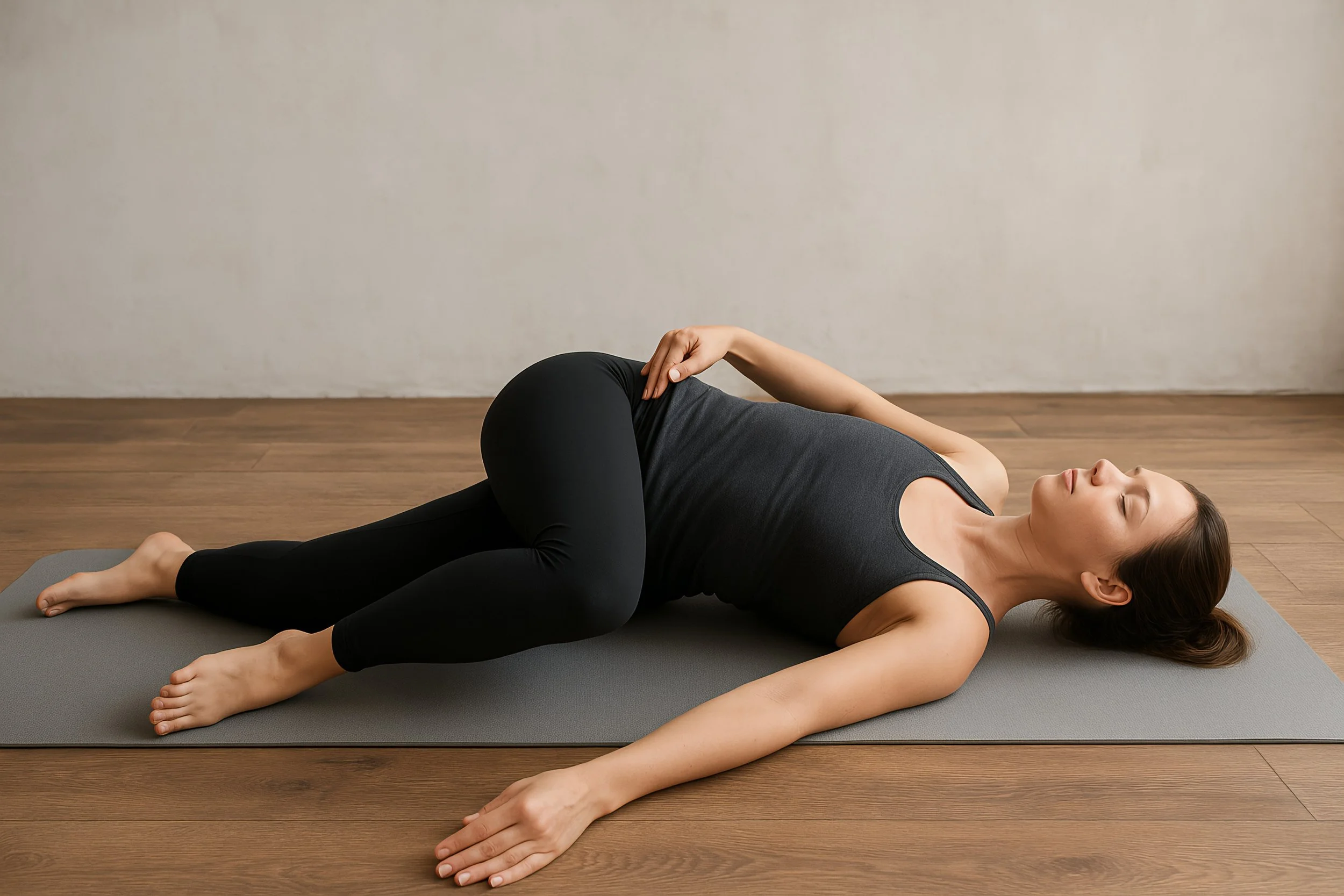
Something has changed.
If you’ve been teaching yoga for any length of time, you’ve probably felt it. The people walking into your classes today are different from the people who showed up five or six years ago. They’re not coming in looking for a workout or a deeper backbend. They’re coming in overwhelmed, under-slept, and running on fumes. They’re restless and sad and worried. Some of them look like they’re barely holding it together. And many of them will tell you, if you ask, that they don’t even know where to start.
I’ve seen this shift firsthand at my own studio. Six years ago, I couldn’t get students into a somatic or nervous system regulation class. They wanted flow, they wanted movement, they wanted to sweat. Today, half of our schedule is nervous system–focused classes — myofascial release, somatics, restorative yoga — and they are by far our most popular offerings. The other half are more traditional classes, but even those now have nervous system regulation woven into every sequence. The demand didn’t shift gradually. It surged.
The question is: why now? And what does this mean for how we teach?
The Modern Epidemic of Restlessness
Having run a yoga studio through the pre-pandemic, pandemic, and post-pandemic years, I can tell you that the shift I’m describing isn’t anecdotal. It’s backed by staggering data.
Since the outbreak of COVID-19, global prevalence of anxiety and depression increased by 25%, according to the World Health Organization. In the United States alone, overdose deaths surged by over 30% in 2020. Deaths associated with alcohol, drugs, and suicide reached 186,763 Americans in a single year — a 20% increase and the highest number of substance misuse deaths ever recorded. The Disaster Distress Helpline saw a 1,000% increase in call volume in 2021 relative to 2019. And in 2019 — before the pandemic even began — the WHO classified burnout as a mental health disorder. Anxiety disorders are now the number-one mental health issue globally, affecting more than 285 million people.
These numbers describe a population in crisis. But what’s important to understand as yoga teachers is what’s driving these numbers: a nervous system epidemic. People aren’t just stressed. Their autonomic nervous systems are stuck — locked in fight-or-flight, or collapsed into shutdown. And when the nervous system is dysregulated, everything downstream suffers: sleep, mood, digestion, pain perception, the ability to focus, the capacity to connect with other people.
They Can’t Sleep. They Can’t Focus. They Can’t Rest.
The insomnia numbers alone should give every yoga teacher pause. Half of American adults experience insomnia at least once a month. One in five struggle to sleep every single night. Among 18–24 year olds, the rate is even higher: nearly one in three. And 90% of people with depression report sleep complaints. Insomnia diagnoses increased 37% from the start of the pandemic to its peak.
Meanwhile, our capacity for sustained attention is in free fall. Americans check their phones an average of 262 times per day — once every five and a half minutes. In 2020, Google searches for “how to get your brain to focus” increased by 300%. Linda Stone coined the term “email apnea” after observing that 80% of people hold their breath or breathe shallowly when responding to email or texting — a chronic, low-grade stress response that most people don’t even know they’re having.
This is what’s walking into your yoga class. Not someone who needs a harder vinyasa. Someone whose nervous system has forgotten how to rest.
The Pandemic Isn’t Over — Not for the Nervous System
Here’s what I think many people miss: the pandemic’s impact on the nervous system didn’t end when lockdowns lifted. During the pandemic, we were told to stay put and isolate. Our nervous systems adapted to that reality — they downregulated social engagement, heightened threat detection, and learned to survive in a contracted, protective mode. Now that the external restrictions are gone, many people don’t know how to get started again. They’re exhausted and paralyzed. The inertia is real, and it’s physiological, not just psychological.
Petterson et al. (2020) projected that the United States could experience 75,000 “deaths of despair” due to the isolation and stress caused by COVID-19. That study warned that without solutions to the nation’s isolation, pain, and suffering, there would be a surge in preventable deaths from drugs, alcohol, and suicide. That projection has largely come to pass.
As yoga teachers, we are not therapists and we are not doctors. But we are often the first point of contact for people who are looking for a way back into their bodies and their lives. And that means we need to understand what’s actually happening in the nervous system — and how to help.
What Your Students Are Really Looking For
When I look at the students filling our nervous system regulation classes, here’s what I see: people who need a safe place to just be. They need permission to stop performing. They need an hour where someone isn’t asking them to accomplish something, where there is no list to get through, no email to answer, no problem to solve. They need rest — real, nervous-system-level rest, not just lying on the couch scrolling their phone.
Somatic yoga and nervous system regulation practices offer something these students have often never experienced: the feeling of their body actually letting go. Not being told to relax, but having the nervous system genuinely downshift into a state of safety. When that happens, students often report things that surprise them — they can suddenly access meditation in a way they never could before, they sleep through the night for the first time in months, they feel a sense of calm that lasts beyond the class.
This isn’t magic. It’s neuroscience. When the autonomic nervous system shifts from sympathetic dominance (fight/flight) or dorsal vagal shutdown (freeze/collapse) into a ventral vagal state — the state of safety, connection, and social engagement described by Stephen Porges’ Polyvagal Theory — the downstream effects are profound. Heart rate variability improves. Inflammatory markers decrease. Sleep architecture normalizes. Pain thresholds rise. The body begins to heal in ways it cannot when it’s stuck in survival mode.
Why This Matters for How You Teach
The demand for this work is not going away. If anything, it’s accelerating. The students who discovered nervous system regulation during or after the pandemic are not going back to a practice that doesn’t include it. And new students are arriving already asking for it — they’ve heard about somatics, about vagus nerve work, about the connection between the body and the brain, and they’re looking for teachers who can guide them with depth and skill.
This is both an opportunity and a responsibility. The opportunity is to offer your students something genuinely transformative — not just a good class, but a practice that changes how they live in their bodies. The responsibility is to learn this work well, so that when a student comes to you exhausted, anxious, unable to sleep, and barely coping, you have real tools to offer them.
Because here’s the truth: they are already in your class. They’re on the mat right now, hoping that this practice can help them. And with the right training, it can.
Sara is a yoga studio owner, teacher, and nervous system regulation specialist. She has watched the demand for somatic and nervous system–focused yoga transform her studio — and her teaching — over the past six years.