WHAT IS THE DEEP YOGA METHOD?
I was a teacher before I was a yoga teacher.
The most important people in my life have always been teachers. My parents were teachers. And my husband is a philosophy academic. As a teacher myself of comparative literature and then writing at Rutgers, the University of Oklahoma, and Texas Tech University, most of my friends are teachers. Even when I changed careers to design healthcare programs for our most vulnerable neighbors, I worked with Universities.
Teaching is in my bones, my blood, and my heart. It is what I know best and what I most respect.
When I started teaching yoga, I brought all of that with me.
Most yoga teachers come to teaching through their love of yoga. I did too. But I started training yoga teachers because I love teaching.
That experience is what makes The Deep Yoga Method different, and the way I train teachers different.
Teaching is in my bones, my blood, and my heart. Love of teaching is the Deep Yoga Method’s foundation.
I grew up in a school.
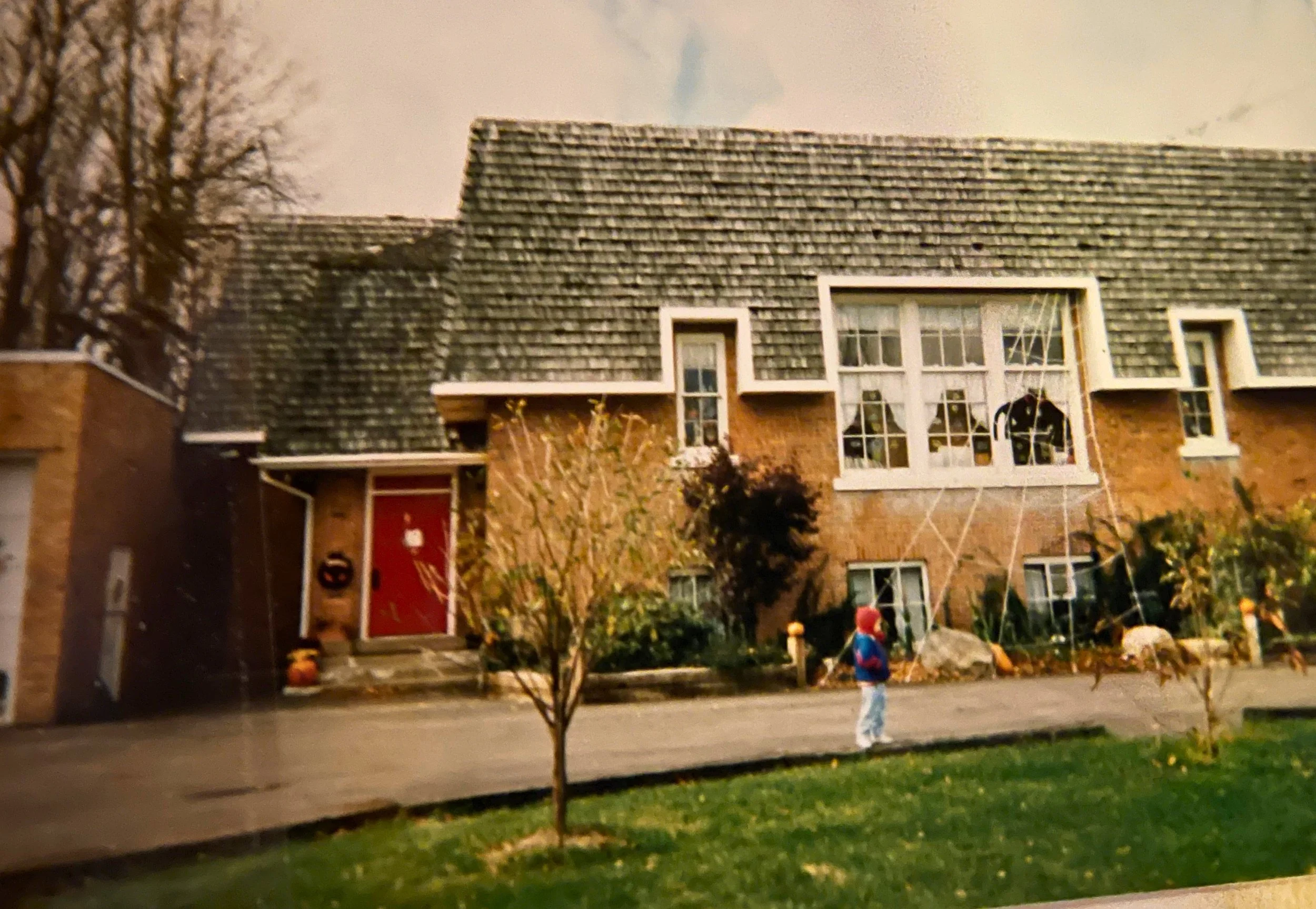
When I was four, my parents bought a school building at auction. They spent four years renovating it, and when I was in fourth grade, they opened the doors. We lived on the first floor; the school was upstairs.
I grew up roller skating through empty classrooms. We looked at playgrounds and visited schools on family vacations. I had 30 little brothers and sisters.
Most importantly, I saw my parents’ eyes brighten when an idea clicked in the mind of a student, and I saw them tailor their approach to the needs of the student when it didn’t.
Much of my approach to teaching and training teachers in yoga stems from what I saw every day of my childhood: To be a teacher, you must know the material at the deepest level. You must try it on from every direction so that you can teach it in a way that is meaningful for every student. The student’s success and joy in learning comes from you.
My parents are in their late seventies now. Eight years ago, they sold the school to a former student. It's still running. Their vision is still alive.
I tell you this because the principle that runs through everything I teach — that the teacher is responsible for the student's success — wasn't something I arrived at through a yoga training. It was in the air I breathed for the first eighteen years of my life.
My childhood was defined by the belief that teaching is the greatest of life’s paths because it changes both your and other people’s lives.
How the Deep Yoga Method came to be.
It sometimes surprises people that the Deep Yoga Method is not a tradition I inherited.
It's a methodology I built — through 1,500+ hours of advanced study with master teachers, eight years developing innovative healthcare and behavioral healthcare programs, eleven years of running a studio, seven years of training yoga teachers, and being a teacher of one kind or another for most of my life.
I draw deeply from my teachers — Tiffany Cruikshank (Yoga Medicine), Jason Crandell, Tias Little, Tracee Stanley, and Dr. Ray Long. I'm profoundly grateful to all of them. But the integration — the specific way classical yoga, modern biomechanics, polyvagal theory, trauma-informed care, and graduate-level pedagogy come together — is the work I've done.
Every Deep Yoga Method teacher trained on our faculty teaches with the same coherence, the same principles, the same commitment to student success. That's by design. A method isn't useful if it lives in only one person.
Why I built the method.
In 2012, I finished treatment for stage 3 breast cancer.
I had already been a yoga teacher for three years, and yoga had been an anchor in my life for a long time.
But the yoga classes I took weren’t working for me anymore. The cues didn't fit the body I now had. I had spent the previous 15 years relying on my flexibility. That didn’t work after surgeries, radiation, and chemo. The teachers were kind, but like most yoga classes, there was no technique.
I went looking for something different. I trained with the teachers I named above. I learned about anatomy (Yoga Medicine), alignment (Jason Crandell), and how the body really works (Dr. Ray Long). I studied pain science, polyvagal theory, and fascia and trauma research. I also learned about yoga history and philosophy and trained with teachers who believe in the soul of what yoga can offer (Tracee Stanley).
I tested everything on myself, and then — once I opened Shine Yoga in 2015 — on students who came to me with chronic pain, autoimmune disorders, anxiety, trauma histories, cancer recovery, perimenopause, and grief.
Deep Yoga Method is a few things at once. It’s a philosophy; it’s a belief in the value of teaching and the power of yoga. It’s also a technique that empowers people to discover the strength and tensegrity in their own bodies.
The Deep Yoga Method is a belief that technique makes yoga accessible to everyone.
The moment I knew this was my path.
I knew the method was real the day I noticed I was taking yoga classes at another studio and cueing myself the entire time.
I'd be in someone else's class, hearing their cues, and silently giving myself my own — the ones I'd developed through all those years of study and practice — to find the engagement, the alignment, the muscle work that let the posture do its job in my body. The teacher's cues weren't wrong. They just weren't precise enough to work for me.
That was the moment I decided to leave my career in program development and writing and become a full-time yoga teacher and trainer. If I was cueing myself, other people needed those cues too.
In the twelve years since, I've trained over a hundred teachers. And I hear the same thing from them, over and over: I take a class somewhere, and I'm cueing myself the whole time with what you taught me, and that's how I find the pose. They're using Deep Yoga Method cues to access engagement and stability in any class, with any teacher, anywhere.
The test of any method is if it’s replicable—whether it transfers, whether it travels with the people who learn it, whether it shows up when you need it without a teacher in the room.
How the pandemic made my trainings better.
For years, the standard 200-hour yoga teacher training format was twelve-hour weekends. Twelve hours Saturday, twelve hours Sunday, repeated until you hit two hundred hours. That's how I was trained. That's how almost every teacher I knew was trained. That's how most schools still do it.
When the pandemic hit, and I couldn’t run my training that way, I realized: no one learns that way.
You can sit in a room for twelve hours. You can absorb maybe three or four of them. The rest is endurance, not education.
I started looking at the format and recognized it for what it was — a structure designed by yoga teachers trying to fit a credentialing requirement into busy schedules, not by educators trying to help adults learn complex material and retain it.
That was the moment something snapped into focus for me. The problem isn't just that some yoga teaching is poorly cued or that some trainings are weak on anatomy. The problem is upstream.
Yoga teacher trainings have largely been designed by yoga teachers, not by educators. The cues, the sequencing, the assessment, the pacing — all of it is built around what's familiar from being a yoga student, not around what produces capable graduates.
The Deep Yoga Method is what happens when you build it the other way around. We start with what we know about how people learn, and we use yoga as the discipline through which we practice the craft.
The Deep Yoga Method isn’t about hitting 200 or 500 hours; it’s about becoming a remarkable teacher.
And why community is just as important.
The Deep Yoga Method is always balancing the science behind yoga, the craft of teaching, and the magic of yoga.
At first glance, the soul, history, and ritual of yoga seem at odds with the science and technique of yoga. But if you look deeper, it’s really not. Polyvagal theory supports connection as the safest state for our reactive nervous systems. Connection and belonging are a means of managing stress responses. And humans can only learn and grow when they feel safe.
A few years ago, a researcher showed that when we move and breathe together, we connect more easily. Boundaries with strangers are broken down ( Barnes et al 2024)
For this reason, all of our programs have an in-person component. Connection is vital, and it is part of what makes yoga profound
Structured for learning without letting go of the human experience that makes yoga remarkable.
The principle the method is built on.
At the heart of it all, our governing principle is that the teacher is responsible for the student’s success. Most yoga assumes the opposite. The teacher demonstrates, the student tries to copy, and if it doesn't work, the student is told to be patient and to honor where they are. Or worse, they are left to compare themselves to other students and believe that yoga isn’t for them.
I reject that. The Deep Yoga Method is built on the conviction that when a student can't access a posture, the failure is in the teaching, not the student. Our job — and I mean this as both a pedagogical commitment and a professional standard — is to give you the cues, the technique, the sequencing, and the adaptations that let you find your strongest expression of any practice, in the body you actually have, today.
This is what we mean by technique over shape. We don't teach you what the pose should look like. We teach you to access the power and alignment in your unique body. The shape is a byproduct of intelligent practice, not the goal of it. And that is why students are able to do postures they never thought they could. Quite simply, they are taught how.
That stance — that the teacher's craft, not the student's effort, determines whether the practice works — is the through-line of everything we teach. When you train with us, it becomes the through-line of your teaching too.
The teacher is responsible for the student's success.
Why the pedagogy is the point.
The Deep Yoga Method teaches you how to teach — and uses yoga as the discipline through which we practice that craft.
That distinction matters. When you train with me, you're learning from someone whose primary craft, for thirty years, has been helping adults learn complex material and apply it well.
The structure of every training, the design of every cue, the sequencing of every module reflects that craft. We use research-informed instructional design because it works — for college students, for healthcare professionals, in continuing education, and for yoga teachers.
It's why my Advanced Certification is structured like a graduate program, with a capstone. It's why I cap cohorts and have a rigorous application process. It's why mentorship is built in rather than optional. And it's why graduates not only know how to teach, they can’t wait to.
Physical and psychological safety is how people grow. Safety comes from a teacher who sees herself as a leader.
The Four Pillars of The Deep Yoga Method
-

Technique over Shape
Teachers trained in this method learn to cue from the inside out.
Instead of telling students what the posture should look like, you learn how to guide a student to feel specific muscles engaging and lengthening.
You learn to see students, not postures, which leads to real embodiment and growth.
-

Nervous System Regulation
Every module of our trainings integrates nervous system science.
You'll graduate able to read a student's nervous system state and respond with practices that regulate it — rather than guessing or following a generic sequence.
You’ll also practice compassion, kindness, and support and learn to develop a culture that helps people feel safe and grow.
-

Evidence Based Biomechanics
You'll learn the reason behind every cue you give and the research behind every adjustment you make.
Our 250-hour certification dedicates a quarter of its hours to anatomy and biomechanics alone — more than most 300-hour programs.
-

Authentic Presence
We don't graduate teachers who depend on a script. We teach you to delve into your own heart and take the time to decide what is most important to you. What you most want to share with other people so they can feel it in their bodies and remember it when they go out into the world.
We graduate teachers who believe in the power of yoga to shift lives, both their students’ and their own.
We teach you to value your voice, your unique presence, and to become the kind of leader you were meant to be.
Is this for You?
You're likely to thrive in one of our programs if you:
Want to understand the why behind every cue you give — and how to teach others to do the same.
Want to understand and embody yoga beyond the poses, but learn the technique behind postures too.
Want to help people with chronic pain, illness, trauma, anxiety, or other complex needs, and want to serve them safely and skillfully.
Are a healthcare provider, therapist, or wellness professional who wants to teach yoga as part of your clinical work.
Want something rigorous, evidence-based, and built by someone who teaches teaching for a living.
Are a yoga teacher ready to build a sustainable career beyond the group-class hustle — through retreats, private sessions, specialized programs, or partnerships with healthcare systems and schools.
Trusted in the field and beyond


If you're ready to study with us, here are some ways to start
If you are a certified teacher ( from any yoga school):
Take a weekend workshop. $299, no prerequisites beyond a 200-hour certification. The lowest-commitment way to experience the method directly.
Enroll in a specialty module or the foundation module. Standalone deep-dives into specific topics, taken at your own pace.
Apply for the Advanced Certification. The full credential, with Cohort or Self-Led paths to fit your life.
If you are looking to become a certified teacher:
Begin the Application Process. The first step is a simple written application, followed by an in-person meeting with Sara.
Come to a class at Shine. See firsthand what you will be learning to do!
Not sure where to start?
Schedule a consultation with me if you'd like to talk through what's right for you!